
Orthodontic treatment no longer always means wearing highly visible fixed brackets. For selected alignment problems, Invisible Aligners provide a removable and relatively discreet approach to gradually repositioning teeth.
This option has attracted particular interest among working adults, college students, and other patients in R.T. Nagar, Karnataka, who want orthodontic treatment with less impact on their everyday appearance.
How Invisible Aligners Work
Aligner treatment uses a planned sequence of transparent trays. Each tray is designed to move selected teeth by controlled amounts before the patient progresses to the next stage.
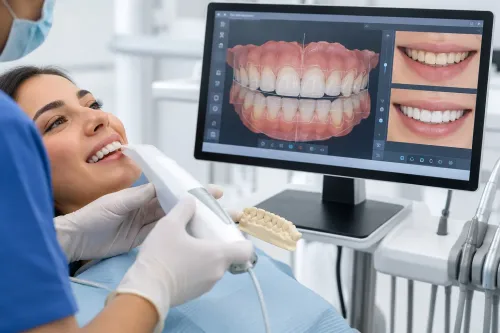
The process typically begins with a dental and orthodontic assessment. Digital scans or other records may then be used to study tooth positions and develop the treatment plan.
Unlike fixed braces, aligners can generally be removed for eating, brushing, and cleaning between teeth.
What Problems Can Aligners Correct
Depending on the individual case, aligners may be considered for:
- Mild to moderate crowding
- Gaps between teeth
- Certain rotated teeth
- Some bite discrepancies
- Relapse after previous orthodontic treatment
However, transparent trays are not automatically suitable for every orthodontic problem.
More complicated tooth movements, significant skeletal discrepancies, severe rotations, or complex bite problems may require a different orthodontic approach.
The Convenience Comes With Responsibility
Removability is one of the biggest practical advantages of aligners, but it also means that treatment depends heavily on patient cooperation.
If trays are frequently left out for long periods, planned tooth movement may not progress as expected.
Patients therefore need to follow their prescribed wearing schedule carefully.
Eating and Oral Hygiene Can Be Simpler
Because aligners are removed during meals, there are generally fewer food restrictions compared with conventional fixed appliances.
Patients can also brush and floss without brackets and wires getting in the way.
However, this does not eliminate hygiene responsibilities. Teeth should be kept clean before the trays are replaced because food particles and plaque can otherwise remain trapped against the tooth surfaces.
Aligners themselves also need appropriate cleaning.
Does Transparent Mean Completely Invisible
Not quite.
Clear trays are less noticeable than many conventional orthodontic appliances, but someone looking closely may still see them. Some cases may also require small tooth-coloured attachments that help the aligners generate particular movements.
The more useful expectation is discreet orthodontic treatment rather than completely invisible treatment.
Treatment Planning Matters More Than the Appliance
Two patients with similar-looking crooked teeth may require different treatment strategies.
A proper evaluation considers:
- Available space
- Root positions
- Gum and bone support
- Bite relationships
- Required tooth movements
- Previous dental work
- Patient compliance
At Orchards Dental Care, patients considering orthodontic correction can be evaluated to determine whether clear aligner therapy matches the complexity of their condition.
Ultimately, successful treatment with Invisible Aligners depends on more than receiving a set of transparent trays. Appropriate case selection, careful planning, consistent wear, progress reviews, and post-treatment retention all contribute to achieving and maintaining the intended alignment.
Keywords