A smile makeover should account for your face, lips, speech, bite, gums, and tooth health—not just produce attractive teeth in a photograph. By understanding the digital records, preview stages, treatment choices, and clinical checks involved, you can judge whether a proposed plan is genuinely personalized and what questions to ask before treatment begins.
Key takeaways
- Treat gum disease, decay and bite problems before cosmetic planning.
- Ask which facial photographs, scans and videos shape your proposed smile.
- Request an in-mouth mock-up before approving irreversible treatment.
- Treat the digital preview as a guide, not a guaranteed final result.
What Digital Smile Design Actually Adds to Treatment Planning
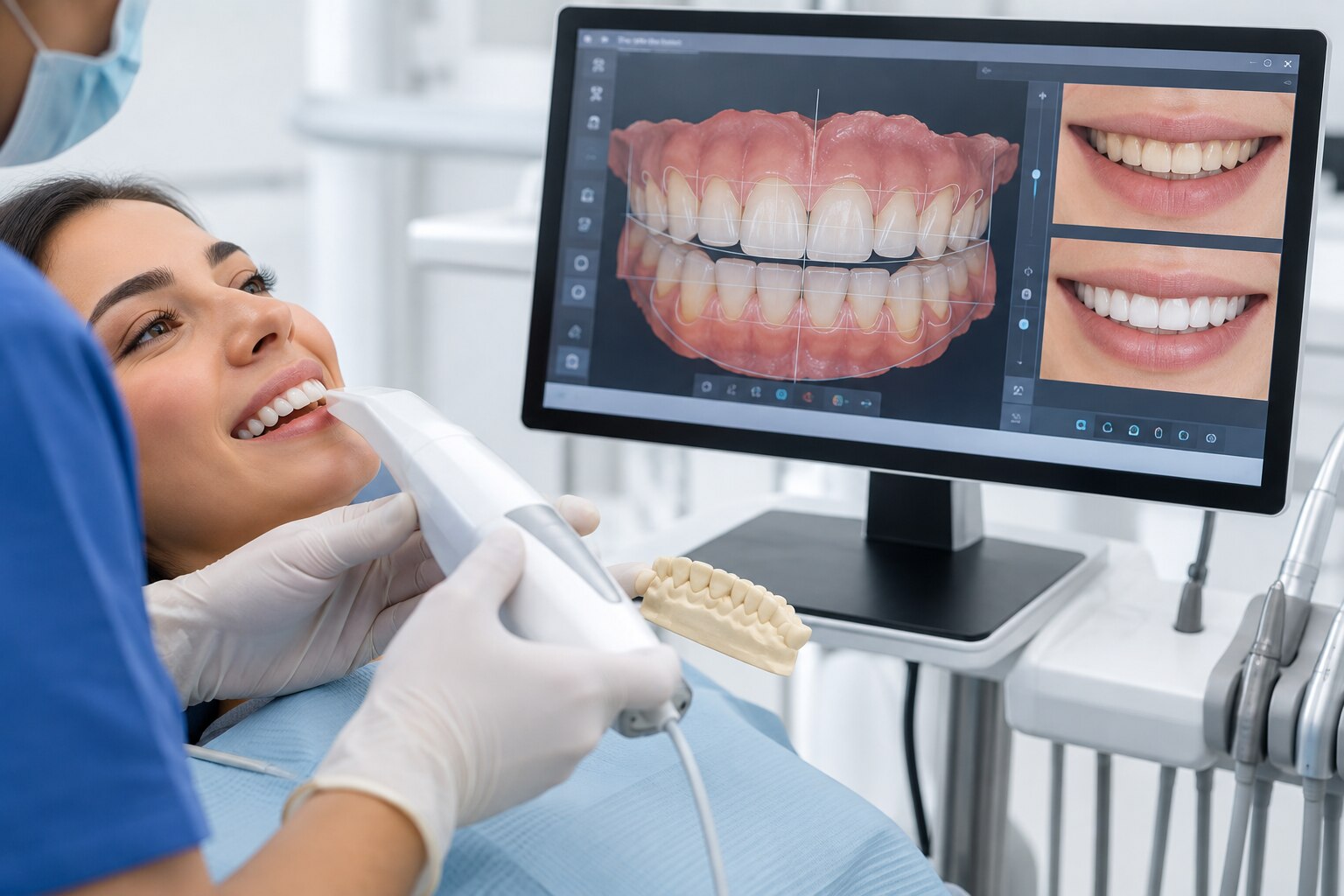
Digital Smile Design is a planning and communication workflow, not a dental treatment. It combines standardized facial photographs, a facial scan, intraoral scans, video, and 2D or 3D digital smile design software to propose how your teeth might be positioned, shaped, and seen within your face.
- The dentist records your face, teeth, bite, and movement rather than relying on one smile photograph.
- The records are aligned in software to create a visual treatment hypothesis for tooth position, proportions, smile line, and gingival display.
- The dentist, dental laboratory, and patient review that proposal together before treatment begins.
- A diagnostic wax-up, printed model, silicone index, or temporary mock-up can transfer the proposal to your mouth for discussion of appearance, speech, lip support, and comfort.
This process makes digital smile makeover planning more concrete: you can discuss the intended result instead of interpreting technical descriptions alone. It does not replace diagnosis. A conventional examination, dental X-rays when indicated, gum assessment, tooth-strength evaluation, bite analysis, and health history determine whether the proposed design is safe and suitable.
The preview is also only as accurate as the records and their alignment. Camera angle, head posture, lighting, lens distortion, movement, and incorrect registration between facial images and tooth scans can make an attractive design appear more precise than it is.
Which Records Shape a Facially Balanced Smile Plan
A balanced design starts with the face, not an isolated tooth. Standardized frontal dental photographs and profile photographs show the facial midline, interpupillary line, lip position, facial asymmetry, and how the dental midline relates to the rest of the face.
| Record | What it reveals |
|---|---|
| Frontal photographs at rest and smiling | Tooth display at rest, smile arc, incisal edge position, gingival display, lip curvature, and midline alignment |
| Profile photographs | Lip support, facial convexity, incisor prominence, and the effect of proposed tooth length on the profile |
| Intraoral photographs | Existing tooth shape, shade, wear, gum levels, restorations, tooth width-to-height ratios, and occlusal relationships |
| Intraoral scan | Three-dimensional tooth positions, arch form, spaces, rotations, and surfaces that a photograph cannot measure |
| Bite record | How upper and lower teeth meet, which contacts affect dental planning, and whether proposed changes could disturb occlusal comfort |
| Video during speech, laughing, and natural lip movement | Changing tooth display, lip mobility, smile asymmetry, speech-related exposure, and whether a posed smile hides movement problems |
The design should compare resting and smiling views rather than treating one photograph as the truth. Video adds information that static images miss: a tooth position that looks even in a posed smile can appear uneven during speech or laughter.
Accuracy depends on capture and registration. Incorrect camera angle, head posture, lighting, lens distortion, or inaccurate alignment of facial photographs with the intraoral scan can make a digital design look exact while producing unreliable measurements.
How the Plan Moves from Digital Simulation to an In-Mouth Test
Approval should follow an in-mouth test, not a screen image alone. The digital smile design workflow usually moves through these steps:
1. Consultation and health assessment: The dentist examines decay, cracks, enamel thickness, tooth vitality, gums, bite, jaw symptoms, and hygiene before planning cosmetic changes.
2. Standardized records: Frontal and profile photographs, resting and smiling views, intraoral scans, bite records, and video of speech and natural lip movement provide the reference data.
3. Digital design: Two-dimensional or three-dimensional software proposes tooth position, length, width, midline, smile arc, gingival contours, and facial symmetry.
4. Patient review: You and the dentist discuss the design on screen, identify changes, and decide whether the proposal fits your goals and facial movement.
5. Physical transfer: A diagnostic wax-up, printed model, or silicone index carries the proposed contours into the mouth.
6. Provisional smile trial: The index creates a digital mock-up or temporary mock-up without permanently preparing teeth. Assess tooth display, lip support, speech, smile arc, symmetry, and occlusal comfort while smiling, talking, and closing your teeth.
7. Treatment: The agreed sequence may include tooth movement, gum treatment, bonding, veneers, crowns, or other procedures.
8. Follow-up: The dentist checks healing, contacts, bite, hygiene access, speech, and appearance, then adjusts or replaces provisional and final restorations.
A mock-up copies shape, not dental health. It cannot show whether enough enamel remains, whether the pulp or gums are healthy, or whether the design will withstand bite forces and stay easy to clean.
Why the Preview Is a Guide, Not a Promise of the Final Smile
A digital smile preview is a communication tool, not a photograph of your finished teeth. A screen rendering or in-mouth mock-up shows proposed contours, but smile simulation limitations include material thickness, available enamel, tooth movement, gum healing, laboratory execution, and the way lips and cheeks move during speech and laughter.
| Feature | Preview or mock-up | Completed restoration |
|---|---|---|
| Tooth form | Proposed length, width, midline, and smile arc | Shape altered by tooth position, material limits, and laboratory finishing |
| Gum and tooth interface | Estimated gingival contour and emergence profile | Changed by gum healing, periodontal treatment, and three-dimensional contours |
| Function | Approximate lip response and bite | Actual speech, dynamic facial movement, and occlusal contacts determine comfort |
A two-dimensional design cannot reliably show how thick a veneer must be, how a crown emerges from the gum, or whether the bite will be easy to clean. Confirm those details with examination, scans, radiographs, and a provisional test before irreversible treatment.
Digital Smile Design helps you compare whitening, bonding, veneers or bonding, crowns, gum contouring, implants, orthodontics, or combinations instead of defaulting to veneers. Crowded teeth or a displaced midline may look better after orthodontics before veneers. Uneven gum levels or excessive gingival display may need periodontal treatment before cosmetic restorations.
Implant placement can follow the intended crown position, while worn teeth may need restorative and bite planning together. The preview guides that choice; it cannot guarantee the final smile.
When to Approve the Plan—and When Health Comes First
Approve the plan only after the dental health assessment explains what will be changed, why it is needed, and how it will remain stable. A personalized smile makeover consultation should leave you with clear answers to these questions:
- What records were used: photographs, scans, bite records, video, radiographs, or facial measurements?
- Which findings are being corrected, and which are only cosmetic preferences?
- How much enamel or tooth structure will be reduced?
- Can you see a diagnostic wax-up, printed model, silicone-index mock-up, or in-mouth trial?
- How will the design affect speech, lip support, tooth display, and bite comfort?
- Were whitening, bonding, orthodontics, gum treatment, crowns, veneers, or implants considered?
- How will uneven gum levels, gingival display, or future gum healing be managed?
- What cleaning, repairs, reviews, and replacement costs will maintenance involve?
Untreated decay, active gum disease, unstable bite problems, severe tooth wear, inadequate hygiene, cracks, pulp concerns, or unresolved jaw symptoms require clinical sequencing before cosmetic design. Treating gum disease before cosmetic dentistry matters because inflammation can alter gum levels and undermine the final margins.
Use this decision guide:
| Stage | What it means | Appropriate action |
|---|---|---|
| Health unstable | Disease, pain, cracks, or bite damage remains | Treat and stabilise first |
| Mock-up review | Proposed contours can be tested in the mouth | Assess speech, appearance, lip movement, and comfort |
| Health stable | Diagnosis, alternatives, risks, and maintenance are clear | Approve treatment with defined follow-up |
Orchards Dental Care 9886020830 can be useful when restorative, orthodontic, implant, gum-care, and cosmetic dentistry must be coordinated. The software name matters less than diagnosis, execution, materials, and follow-up.
Related services
Smile Designing Transform Your Smile with Expert Smile Designing at Orchards Dental Care At Orchards Dental Care, Sadashiva Nagar, Bangalore, we believe every smile... View service → |
Cosmetic Dentistry Transform Your Smile with Advanced Cosmetic Dentistry at Orchards Dental Care At Orchards Dental Care, Sadashiva Nagar, Bangalore, we offer... View service → |
Frequently asked questions
What does Digital Smile Design add to treatment planning?
It combines facial photographs, scans, video and digital software to show how proposed tooth changes may look within your face.
Which records are used to create a personalized smile plan?
The plan can use standardized facial photographs, a facial scan, intraoral scans and video of your natural expressions and speech.
How does a digital smile plan become an in-mouth test?
The proposed design can be transferred into a temporary mock-up or trial restoration so you can assess its appearance and function in your mouth.
Does a digital smile preview guarantee the final result?
No. It is a communication and planning guide; materials, tooth movement, gum changes, laboratory work and healing can alter the final result.
When should health come before approving a smile makeover?
Address active decay, gum disease, infection, uncontrolled grinding and unresolved bite problems before approving cosmetic treatment.